Monday, September 7, 2009

Confederation Bridge


The bridge is a two-lane highway toll bridge that carries the Trans-Canada Highway between Borden-Carleton, Prince Edward Island (at Route 1) and Cape Jourimain, New Brunswick (at Route 16).

It is a multi-span post-tensioned concrete box girder structure. Most of the curved bridge is 40 metres (131 ft) above water, and it contains a 60 m (197 ft) high navigation span to permit ship traffic. The bridge rests on 62 piers, of which the 44 main piers are 250 m (820 ft) apart. The bridge is 11 m (36 ft) wide.

The speed limit on the bridge is 80 kilometres per hour (50 mph). It takes about 10 minutes to cross the bridge.

Prince Edward Island


Prince Edward Island is Canada's smallest and greenest province. Cradled on the waves of the Gulf of St. Lawrence, PEI is known for the vivid colours of its gently rolling landscape. Prince Edward Island is surrounded by miles of sandy beaches and red sandstone cliffs and is sized just right for touring.

Prince Edward Island Cuisine


Dining in PEI, Island Foods, PEI Restaurants
On an island where the primary industries are farming and fishing, fresh is the operative word when it comes to food experiences. Prince Edward Island is famous for its oysters, mussels and even potatoes, and now visitors can enjoy "field to table"
PEI Restaurants culinary touring with a range of hands-on food experiences. On the Island the "100-mile diet" becomes the 10-mile diet as the lobster on your plate may have been harvested on the fishing boat at the dock outside the window and the salad is made up of herbs and greens from the garden in the yard.

Curious about how those delicious lobsters are caught, or how to shuck an oyster properly? Sign up for a guided experience on a lobster boat or a fishing dory. For a full-on foodie weekend, take a look at the PEI fall schedule - not one, but two, amazing fall food festivals are on the September/October calendars.

The PEI International Shellfish Festival is a lively three days filled with music, mussels and oysters plus the intensely exciting shucking competitions. In late September more than 100 events pack the Fall Flavours festival agenda. Culinary keeners go from smoking and pickling workshops, to oyster tonging and potato picking, to spectacular fine dining with top chefs cooking up nine-course extravaganzas.

Wednesday, September 2, 2009

Whale Watching


Whale watching as an organized activity dates back to 1950 when the Cabrillo National Monument in San Diego was declared a public spot for the observation of Gray Whales. In 1955 the first water-based whale watching commenced in the same area, charging customers $1 per trip to view the whales at closer quarters. The spectacle proved popular, attracting 10,000 visitors in its first year and many more in subsequent years. The industry spread throughout the western coast of the United States over the following decade.

In 1971 the Montreal Zoological Society commenced the first commercial whale watching activity on the eastern side of North America, offering trips in the St. Lawrence River to view Fin and Beluga Whales.

In the late 1970s the industry mushroomed in size thanks to operations in New England. By 1985 more visitors watched whales from New England than California. The rapid growth in this area has been attributed to the relatively dense population of Humpback Whales, whose acrobatic behaviour such as breaching (jumping out of the water) and tail-slapping was an obvious crowd-pleaser, and the close proximity of whale populations to the large cities on the east coast of the US.

Throughout the 1980s and 1990s whale watching spread throughout the world. In 1998 Erich Hoyt carried out the largest systematic study of whale watching yet undertaken and concluded that whale watching trips were now available in 87 countries around the world, with over 9 million participants generating an income to whale watcher operators and supporting infrastructure (such as accommodation, restaurants and souvenirs) of over one billion dollars. His estimate for 2000 was for 11.3 million participants spending $1.475 billion, representing a five-fold increase over the decade.

Whale watching is of particular importance to developing countries as coastal communities start to profit directly from the whales' presence, significantly adding to popular support for the full protection of these animals from any resumption of commercial whaling.

Martha's Vineyard


The Vineyard grew as a tourist destination primarily because of its very pleasant summer weather (during summers, the temperature rarely breaks 90°F) and many beautiful beaches. It is primarily a place where people go to relax. Most social life and activity takes place at people's houses, not in the very small towns.

During the whaling era, wealthy Boston sea captains and merchant traders often created estates on Martha's Vineyard with their trading profits. Today, the Vineyard has become one of the Northeast's most prominent summering havens, having attracted numerous celebrity regulars. Martha's Vineyard Airport links the island to the mainland with scheduled air carrier service.

The island now boasts a year-round population of about 15,000 people in six towns; in summer, the population swells to 100,000 residents, with more than 25,000 additional short-term visitors coming and going on the ferries during the summer season. The most crowded weekend is July 4, followed by the late-August weekend of the Agricultural Fair. In general, the summer season runs from June through Labor Day weekend, coinciding with the months most American children are not in school.

In 1985, the two islands of Martha's Vineyard and Chappaquiddick Island were included in a new American Viticultural Area designation for wine appellation of origin specification: Martha's Vineyard AVA. Wines produced from grapes grown on the two islands can be sold with labels that carry the Martha's Vineyard AVA designation. Martha's Vineyard is home to the winemaker Chicama Vineyards in West Tisbury. Various writers have been inspired by the island—including the mystery writer Philip Craig who set several novels on the island.

Other popular attractions include the annual Illumination Festival in Oak Bluffs; the Martha's Vineyard Film Festival and Cinema Circus which runs its Summer Film Series and Cinema Circus every Wednesday in July and August, and it's Winter Festival in March; Martha's Vineyard International Film Festival in September, Katama Farm in Edgartown; and the Flying Horses in Oak Bluffs, the oldest carousel in the United States.

The New England Clam Bake


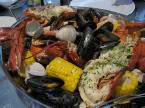
The New England Clam Bake is a traditional method of cooking foods, especially seafood such as lobster, mussels, crabs, steamers, and quahogs. The seafood is often supplemented by sausages, potatoes, onions, carrots, corn on the cob, etc. Clam bakes are usually held on festive occasions along the coast of New England.

METHOD

A typical clam bake begins with gathering seaweed at the shoreline; seaweed is an important adjunct to cooking the food. To keep the seaweed fresh, it is necessary to have a container large enough to hold both the seaweed and a fair amount of sea water.

Also important are several round medium-sized stones, or sometimes cannon balls, which are heated in the fire and used to re-radiate heat during the cooking process.

Lastly, like most other methods of steaming, a cover is necessary to allow the trapped heat and steam to thoroughly cook the food. Canvas tarps or potato sacks soaked in sea water are often used for this purpose.

Once the stones and seaweed have been collected, a fire pit is prepared. Some prefer to simply start a fire within the pit, while others line the edges with flat stones to provide support for a metal grill on which the stones may be placed; others prefer to dig a pit dug out on the beach so that the food may "bake" under the sand.

The stones used for cooking are then placed in the center of the pit and a wood fire is started, although the exact method of heating the stones varies. The fire must burn until the stones are glowing hot. Care must be taken to ensure that the fire will burn out shortly after this optimal cooking temperature is achieved. The ashes are then swept off the stones and raked between them to form an insulating "bed". A layer of wet seaweed is place over the stones, followed by traditional regional foods such as steamer clams, mussels, quahogs, and lobsters. Side dishes usually include potatoes, corn on the cob, linguiƧa sausages, carrots, and onions. Alternating layers of seaweed and food are piled on top and the entire mound is covered with canvas that has been drenched in sea water to seal in the heat and prevent the canvas from burning. (Some may prefer to use beer to soak the canvas, but it is unlikely to have any effect whatever on the cooked food.) The food is allowed to steam for several hours.

Since many locales outlaw building fires on beaches, and in order to accommodate the dish in homes or backyards, this dish is often prepared in a large pot. This is known as a New England Clam Boil. There are some caterers that specialize in clam bakes on the beach.

Tuesday, September 1, 2009

Aurora Borealis


Auroras, sometimes called the northern and southern (polar) lights or aurorae (singular: aurora), are natural light displays in the sky, usually observed at night, particularly in the polar regions. They typically occur in the ionosphere. They are also referred to as polar auroras. In northern latitudes, the effect is known as the aurora borealis, named after the Roman goddess of dawn, Aurora, and the Greek name for north wind, Boreas by Pierre Gassendi in 1621. The aurora borealis is also called the northern polar lights, as it is only visible in the sky from the Northern Hemisphere, the chance of visibility increasing with proximity to the North Magnetic Pole, which is currently in the arctic islands of northern Canada. Auroras seen near the magnetic pole may be high overhead, but from further away, they illuminate the northern horizon as a greenish glow or sometimes a faint red, as if the sun were rising from an unusual direction. The aurora borealis most often occurs from September to October and from March to April. The northern lights have had a number of names throughout history. The Cree people call this phenomenon the "Dance of the Spirits." Auroras can be spotted throughout the world. It is most visible closer to the poles due to the longer periods of darkness and the magnetic field.

Preparing filet mignon


Filet can be cut into 1-2 inch thick portions, then grilled and served as-is. One can also find the filet in stores already cut into portions and wrapped with bacon. High heat is the usual method for cooking the filet. Either grilling, pan frying, broiling, or roasting is preferred.

Bacon is often used in cooking the fillet because of the low levels of fat found in the filet (see barding and larding). Filets also have low levels of marbling, or internal fat. Bacon is wrapped around the filet and pinned closed with a wooden toothpick. This adds flavor and keeps the fillet from drying out during the cooking process. Traditionally, filet mignon is seared on each side using intense heat for a short time and then transferred to a lower heat to cook the meat all the way through. Filet mignon is often served rarer than other meats. Those who prefer a more well-done steak can request a "butterflied" filet, meaning that meat is cut down the middle, and opened up to expose more of the meat to heat during the cooking process.

Machu Picchu, Peru


7,000 feet above sea level and nestled on a small hilltop between the Andean Mountain Range, the majestic city soars above the Urabamba Valley below. The Incan built structure has been deemed the “Lost Cities”, unknown until its relatively recent discovery in 1911. Archaeologists estimate that approximately 1200 people could have lived in the area, though many theorize it was most likely a retreat for Incan rulers. Due to it’s isolation from the rest of Peru, living in the area full time would require traveling great distances just to reach the nearest village.